Healthcare Operations Consulting for Healthcare Teams
By CJ Marshall, President & Founder
Discover how healthcare operations consulting aligns clinical workflows, clarifies leadership roles, and improves care delivery without disrupting your staff.

Article by
Chelvis “CJ” Marshall
Chelvis “CJ” Marshall is President and Founder of Marshall Solutions Group, a management consulting firm specializing in Strategy & Operations, Organizational Leadership & Change, and Program & Project Management.
A retired U.S. Navy Senior Chief who advanced from E-1 to E-8 in 10 years, CJ transitioned into Fortune 500 enterprise sales and leadership, generating more than $20 million in commercial sales. He brings extensive operational experience leading teams, managing complex programs, and overseeing mission-critical operations.
His work focuses on bridging leadership and execution, helping organizations translate strategic priorities into disciplined execution, organizational accountability, and measurable business outcomes.
Patient care depends on more than clinical expertise. Healthcare operations consulting helps organizations improve how work is organized, decisions are made, and resources are used while keeping care delivery in focus. This work may include assessing operating models, clarifying responsibilities, and redesigning workflows that slow teams down or make execution inconsistent.
Healthcare leaders know operational changes must work for the people delivering and supporting care, not just look sound on paper. This article explains what healthcare consulting covers, how consultants assess and reshape operating models and workflows, and which organizations may benefit. It also distinguishes operational consulting from other specialties, helping you understand where a consultant’s role begins and what organizational challenges it can address.
Key Takeaways
- Healthcare consulting can address operational, strategic, and implementation challenges; identify which problem needs attention before choosing a response.
- Redesign workflows around how care teams actually work, with clear ownership for putting changes into practice.
- Consultant roles vary by specialty and organization, so match the support to the decisions and teams involved.
- An operational assessment can help clarify where leadership or operational friction is getting in the way of execution.
Table of Contents
What is Healthcare Consulting?
Healthcare consulting helps organizations address strategic, management, and operational challenges. For example, improving patient scheduling may require workflow changes, data review, and coordinated implementation.
Operations and Management Consulting
Healthcare operations consulting focuses on how work moves across providers, teams, and processes. Healthcare management consulting is broader, often covering organizational strategy, leadership, and business decisions alongside operations. For technology initiatives, consultants can evaluate current practices, coordinate implementation, and track whether teams adopt new workflows. A scheduling system, for example, must fit staff responsibilities and patient access needs, not merely launch successfully.
Costs depend on scope, complexity, duration, and the expertise required; pricing is provided after a quote request. Fees may be structured around a defined project, time spent, or ongoing advisory support.
Regulatory and Privacy Considerations
In the United States, operations work must account for the healthcare privacy and regulatory requirements that apply to the organization, its data, and its processes. Relevant obligations depend on the information handled and the work being changed. During an evaluation, define who can access patient information, how data moves between systems, and which teams own each step. Address these controls before testing new technology or changing documentation practices.
Operations Improvement Metrics
Choose measures that connect workflow changes to patient service and organizational performance. Useful indicators include appointment wait times, scheduling delays, claim denials, rework, and staff adoption of a new process. Revenue measures can help leaders assess financial effects, but should be considered alongside service and workload measures.
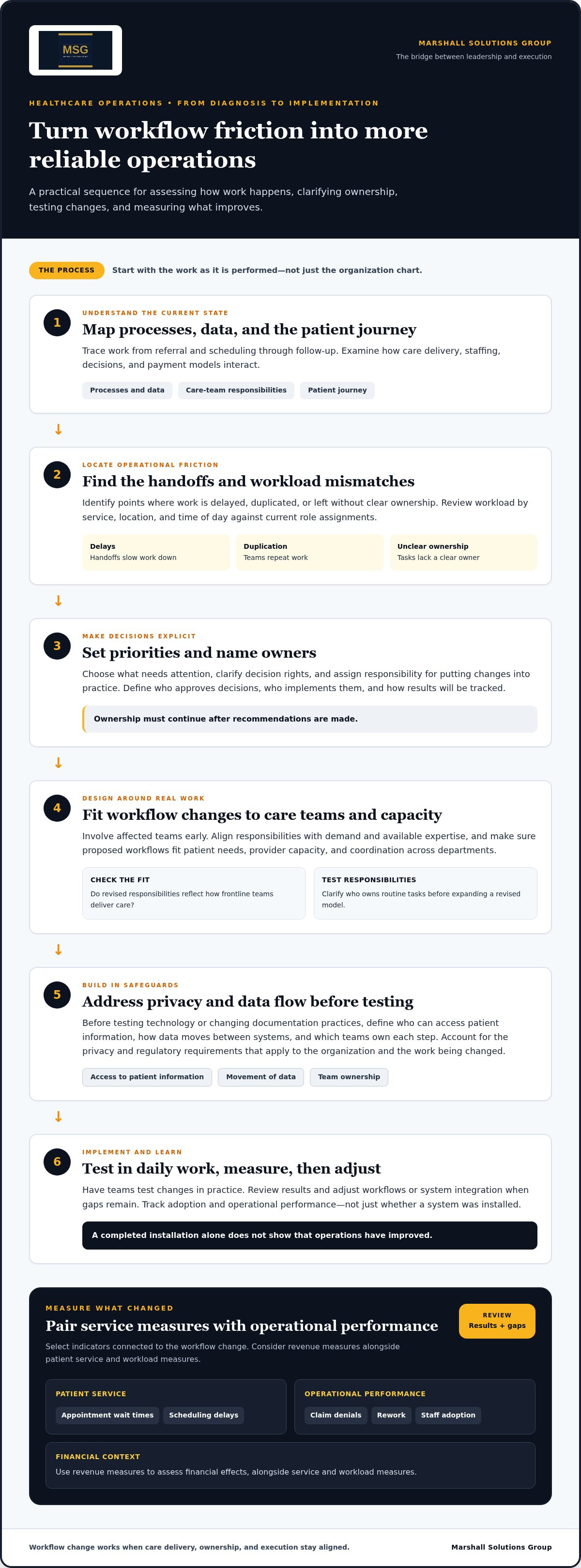
A typical engagement begins by evaluating current processes and data, then setting priorities, assigning owners, and planning implementation. Teams test changes in daily work, review results, and adjust workflows or system integration where gaps remain. For digital transformation, assess whether health information technology supports the intended process and whether teams can use it consistently. A completed installation alone does not show that operations have improved.
Operating model and workflow redesign
Redesign starts by examining how care delivery, staffing, decisions, and payment models interact. A hospital’s transformation plan must fit frontline work, not just its organizational chart.
Care Delivery Model Redesign
Consultants map the patient journey across settings, from referral and scheduling through follow-up. They identify handoffs that cause delays, duplicate work, or unclear ownership. A hypothetical outpatient redesign might move routine follow-up to a different care setting while preserving clear escalation paths for complex needs. The right model depends on patient needs, provider capacity, and coordination across departments.
Value-based payment models make alignment especially important: care delivery practices and operational responsibilities need to support the outcomes the organization is accountable for. Leaders should assess whether workflow changes match those priorities rather than redesign processes in isolation.
Staffing Model Optimization
Staffing model optimization examines how responsibilities and available expertise align with demand. Review workload patterns by service, location, and time of day, then compare them with current role assignments. For example, a hospital may find that routine administrative tasks interrupt clinicians’ patient-facing work. Clarifying who owns each task can reduce handoff friction without assuming every pressure point requires additional staff.
Implementation depends on involving affected teams early. Explain what is changing, define decision rights, and test revised responsibilities before expanding them. Organizational Leadership & Change can support the leadership alignment needed to put a redesigned model into practice.
Balancing patient care with business operations can be particularly difficult for healthcare providers, especially when new workflows affect daily responsibilities. Freed works with frontline professionals who manage day-to-day healthcare operations when developing solutions, helping ensure that proposed changes reflect operational realities as well as care priorities. Their involvement can surface practical constraints early and support workable implementation.
Healthcare consultant roles and client organizations
Healthcare consultants work as contracted advisors for organizations across the healthcare landscape. Their clients include providers, managed care organizations and payors, pharmaceutical companies, pharmacies, medical equipment companies, and biotechnology firms. The role depends on the problem: a provider may need workflow analysis, while a payor may need help assessing contract practices.
Strategy consultants examine an organization’s finances, workforce, relationships, business model, performance, and mission to connect priorities with operating decisions. Human resources and operations consultants may focus on hiring practices, professional development, retention, or patient experience. Senior consultants can also help leaders plan where an organization should be headed over five to ten years.
To choose a healthcare operations consulting firm, match its proposed work to your organization’s specific challenge and desired outcomes. Look for a clear scope, named decision owners, frontline input, and measures tied to patient care and operational performance.
Risks include recommendations that overlook how teams deliver care, unclear ownership after the consultant’s work ends, and changes that disrupt existing workflows. Before work begins, define who approves decisions, who implements them, and how leaders will track results.
Consultants often support defined projects, while some larger organizations retain advisors for ongoing evaluation. The right arrangement depends on whether leaders need focused expertise for a specific issue or continued support as priorities change. Set review points so executives can assess progress, resolve tradeoffs, and adjust the scope as operational needs shift.
Healthcare consulting firms act as contracted third-party advisors to organizations in the healthcare sector. Consultants often work on defined projects to address specific organizational challenges.
Marshall Solutions Group: Operational Assessment
Marshall Solutions Group helps healthcare leaders clarify operational priorities and address execution barriers through an operational assessment. Consider this support when responsibilities are unclear, initiatives compete for attention, or leadership decisions aren’t translating into coordinated action.
The assessment examines how leadership, processes, and accountability connect to organizational goals. Strategy & Operations can then support planning and execution, while Organizational Leadership & Change helps leaders align teams around new ways of working. Program & Project Management can bring structure to complex initiatives through clear ownership, decision-making, and progress tracking.
The focus is management and execution, not clinical care or technical health-system implementation. If your team needs clearer priorities and stronger coordination, contact Marshall Solutions Group to discuss the challenge.
Turn operational priorities into coordinated action
Before launching another initiative, identify which decision is holding up progress and who has the authority to resolve it. This focused starting point helps leaders determine whether the obstacle is unclear ownership, competing priorities, or a process that no longer fits the work.
Use that diagnosis to set a clear next move and keep responsibility with the leaders closest to the issue. If your team is ready to discuss its organizational challenge, contact Marshall Solutions Group. A deliberate first step can help your organization move forward with greater focus.
Frequently Asked Questions
What does healthcare operations consulting include?
Healthcare operations consulting helps leaders organize and execute operational changes. The work may include setting decision rights, coordinating teams, and establishing governance for complex initiatives. For example, a clinic expansion may need an accountable executive, clear dependencies between departments, milestone reviews, and a way to escalate unresolved decisions. The focus is on how people and processes deliver the organization’s priorities.
What problems do healthcare operations consultants solve?
Consultants help address execution problems such as competing priorities, unclear accountability, duplicated approvals, and initiatives that stall between departments. For example, when a new service line requires coordinated decisions from clinical, finance, and administrative leaders, a consultant can clarify who owns each decision and how conflicts reach leadership. This support focuses on organizational execution, not clinical judgment.
How do healthcare operations consultants improve hospital efficiency and patient flow?
Consultants examine where work waits between operational stages, then help leaders address the specific constraint. For example, if discharge plans are delayed by unresolved coordination tasks, teams can assign an owner and establish an escalation process. Leaders should also check whether changes shift delays elsewhere, such as creating bottlenecks for admissions or downstream services.
Which healthcare operations consulting firms serve organizations in the United States?
Marshall Solutions Group supports healthcare leaders with an operational assessment, Strategy & Operations, Organizational Leadership & Change, and Program & Project Management. Healthcare consulting firms may also serve providers, managed care organizations and payors, pharmaceutical companies, pharmacies, medical equipment companies, and biotechnology firms.
Disclaimer
The information provided in this article is for general informational and educational purposes only and does not constitute legal, financial, accounting, engineering, or other professional advice. Marshall Solutions Group, Inc. makes no representations or warranties regarding the completeness or applicability of this information to any specific situation. Readers should consult appropriately qualified professionals before making decisions requiring specialized professional advice.